

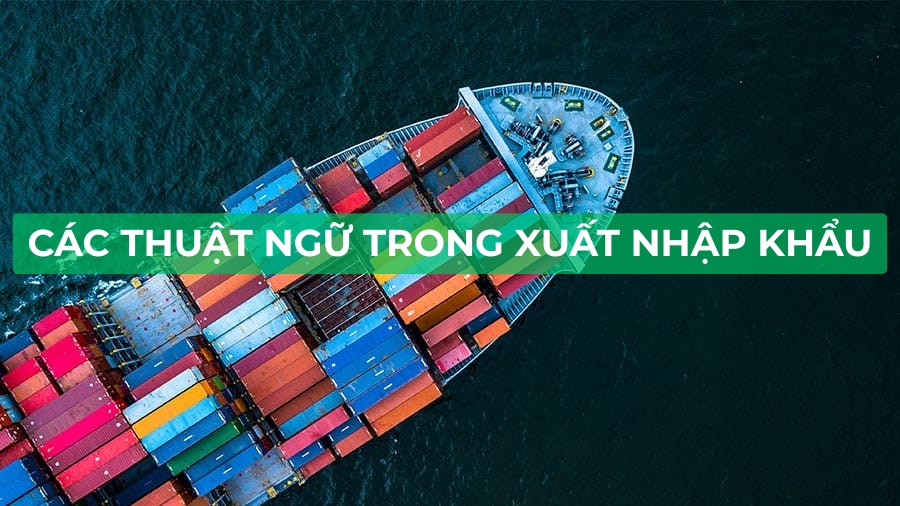
When businesses first enter the export industry, they frequently encounter terms such as FOB, CIF, Bill of Lading, HS Code, and many others. Understanding import and export terminology correctly helps reduce transaction errors and enables businesses to work more effectively with partners. In this article, VinaOpen introduces some of the most commonly used industry terms to help businesses better understand import-export processes and operations.
Export Documentation Terms
Businesses regularly work with various documents to support import and export activities. Common document-related import and export terms include:
- Commercial Invoice: A document showing the value of goods in an import-export transaction.
- Packing List: A document describing the detailed packing method and packaging information of goods.
- Sales Contract: A legal document recording agreements between buyers and sellers in international trade.
- Bill of Lading (B/L): A transport document issued by a shipping line confirming receipt of cargo.
- Air Waybill (AWB): A transport document used for goods shipped by air.
- Certificate of Origin (C/O): A document certifying the origin of goods.
- Customs Declaration: A document used to declare cargo information to customs authorities.
- Insurance Certificate: A document confirming that the shipment has been insured.
- Certificate of Analysis (COA): A document providing testing results and technical specifications of a product.
- Certificate of Quality (CQ): A document certifying that a product meets quality standards.
Read more: What Documents Are Required in an Export Documentation Set? Export Documentation Processing and Management Guide
Logistics-Related Import and Export Terms
The following terms are commonly used in transportation and cargo handling activities:
- Freight Forwarder: An intermediary company that organizes international cargo transportation.
- Carrier: The party directly responsible for transporting goods.
- ETD (Estimated Time of Departure): The expected departure time of a shipment.
- ETA (Estimated Time of Arrival): The expected arrival time at the destination port.
- Lead Time: The total time from placing an order until the goods are delivered.
- Transit Time: The actual transportation time of goods, excluding cargo preparation and customs clearance time.
- Booking: The process of reserving cargo space according to a transportation schedule.
- Container (Cont): A standardized cargo unit used in international transportation.
- LCL (Less than Container Load): A shipping method where multiple shippers share space in the same container.
- FCL (Full Container Load): A shipping method where a single shipper uses an entire container.
- Warehouse: A location used for storing goods during production, transportation, or distribution.
- Demurrage: Charges incurred when a container remains at the port beyond the free storage period.
- Detention: Charges incurred when a container is kept outside the port or at the customer’s warehouse beyond the free usage period.
- CY (Container Yard): A designated area at a port where containers are stored before loading onto vessels or after unloading.
These transportation-related terms form a fundamental part of import-export operations.
Shipping Documentation Terms
During the delivery process, businesses must prepare and exchange numerous documents with buyers. Common terms related to shipping documentation include:
- Shipping Documents: A complete set of documents used during the export process.
- Shipping Instruction (SI): A document provided by the shipper for issuing a Bill of Lading.
- Draft Bill of Lading: A preliminary version of the Bill of Lading sent to the shipper for verification before the final version is issued.
- Original Bill of Lading: The legally valid Bill of Lading used to claim cargo.
- Telex Release: A cargo release method that does not require presentation of the original Bill of Lading.
- Proof of Delivery (POD): A document confirming successful delivery of goods.
- Document Submission: The process by which exporters submit shipping documents to buyers or banks for payment purposes.
Businesses must clearly understand and prepare all required shipping documents to ensure smooth cargo delivery.
International Payment Terms in Import and Export
International payment is one of the most important aspects of import-export operations and involves many specialized terms, including:
- L/C (Letter of Credit): A payment guarantee issued by a bank.
- T/T (Telegraphic Transfer): A payment method conducted through bank transfers.
- Advance Payment: A payment method in which the buyer pays part or all of the order value in advance.
- Open Account (O/A): A payment arrangement where the seller ships goods before receiving payment.
- Documents Against Payment (D/P): A collection method where shipping documents are released only after payment is made.
- Documents Against Acceptance (D/A): A collection method where documents are released after the buyer accepts a bill of exchange.
- Remittance: The transfer of funds from one country to another through the banking system.
- SWIFT (Society for Worldwide Interbank Financial Telecommunication): The global financial messaging network used by banks.
- Beneficiary: The individual or company receiving payment in an international transaction.
- Applicant: The buyer or importer requesting the issuance of a Letter of Credit.
- Issuing Bank: The buyer’s bank that issues the Letter of Credit and guarantees payment.
- Advising Bank: The bank in the seller’s country responsible for notifying the exporter of the Letter of Credit.
- Negotiating Bank: The bank that examines documents and processes payment to the exporter.
- Bill of Exchange (B/E): A financial instrument requiring one party to pay a specified amount to another party.
- Payment Terms: The payment conditions specified in an international sales contract.
International payment activities involve numerous methods and supporting documents that businesses must understand thoroughly.
Import and Export Terms Related to Trade Transactions
During customer acquisition, negotiations, and the signing of international trade contracts, businesses frequently use terminology related to international commercial transactions.
- RFQ (Request for Quotation): A document sent by a buyer requesting a quotation from a supplier.
- Quotation: A document providing information on products, pricing, delivery conditions, delivery schedules, and commercial terms.
- MOQ (Minimum Order Quantity): The minimum quantity of goods a supplier is willing to accept for an order.
- Sample: A product sample sent to customers for evaluating quality, design, specifications, and other factors.
- Lead: An individual or company with purchasing potential but without an actual transaction yet.
- Buyer Inquiry: A request sent to a supplier seeking information about products, supply capabilities, or pricing.
- Purchase Order (PO): A document issued by the buyer confirming an order request.
- Sales Confirmation (SC): A document confirming that both parties have agreed on transaction terms.
- OEM (Original Equipment Manufacturing): A manufacturing model in which products are produced according to the customer’s specifications.
- ODM (Original Design Manufacturer): A model in which the manufacturer designs and produces products that are sold under the customer’s brand.
- Private Label: A manufacturing model where products are produced and sold under the customer’s proprietary brand name.
In international trade activities, businesses regularly conduct negotiations and sign foreign trade contracts.
Conclusion
In summary, understanding import and export terminology is a fundamental requirement for businesses seeking to work effectively with international buyers, logistics providers, banks, and customs authorities.
VinaOpen hopes that the information shared in this article will help businesses strengthen their export capabilities, improve their competitiveness, and integrate more successfully into the global marketplace.